Consultant and product builder
Sergei Gotin
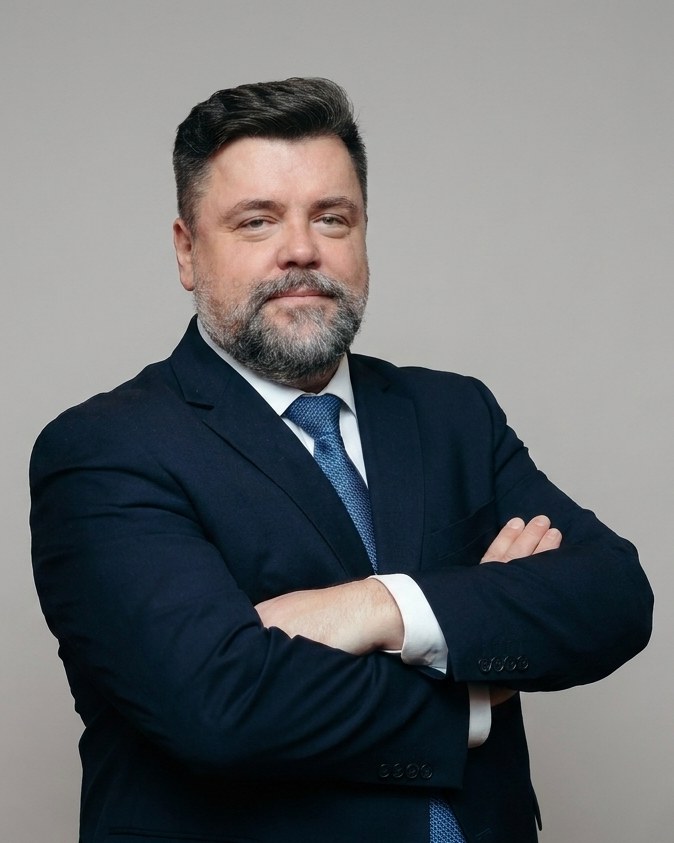
Strategy, evaluation and AI tools that keep the evidence traceable. I help small and medium-sized companies, funders and non-profit organisations make decisions on evidence. For more than twenty years I have done this as a consultant and evaluator. Now I also build AI products that take over the routine part of that work and show where every figure and quote comes from.
About
I started in 2003 as a trainer in project cycle management and the logical framework approach. Since then I have run strategy sessions and business plans for companies, organisational assessments for NGOs and networks, and about fifty independent evaluations and reviews for the European Union, UN agencies and international NGOs across Eastern Europe, the South Caucasus, Central Asia and the Western Balkans.
Since 2010 my consulting work has carried the IMACON brand (imacon.org). I am a qualified consultant of the EBRD Advice for Small Businesses programme in Poland and a member of the Polish Evaluation Society.
In 2025 I started building my own AI tools. The rule is the one I learned in evaluation: a conclusion is only as good as the evidence behind it, and a person checks it before it leaves the desk.
Products and startups
Each product grew out of a task I kept doing by hand. Stages are stated as they are.
Stage: closed beta
AI assessment of organisational capacity — startup
A full organisational capacity assessment by a consultant costs hundreds or thousands of euros and takes weeks, so most small NGOs never get one. This startup turns an assessment method tested in many field assessments into an online service. The organisation describes itself through its own documents. The AI then assesses it from the viewpoint of each stakeholder group, and the report shows where the views agree, where they differ and what nobody sees. A training simulator lets managers try out decisions and see how they change the resilience score. The core service is free for NGOs.
Stage: taking orders
Ladzim — a website the client owns
Ladzim moves an existing website or builds a new one, up to ten pages, and hands everything over. The code sits in the client’s GitHub, the hosting in the client’s Cloudflare account, and the domain stays with the client’s registrar. The client sees a prototype of one or two pages before paying. AI prepares the draft; a person checks it, answers for it and publishes it. Fixed price from €299 net.
Stage: prototype, tested on four real cases; looking for a hospital partner for a pilot
Consilium — preparing complex medical cases for a case conference
Before a multidisciplinary case conference, doctors need the whole case in one place: what is known, what each decision rests on, and what is still open. Consilium builds a master record from scans and transcripts of medical documents and checks it for completeness. It checks every number and every “no” against the source document and links the relevant literature. Two models review the result independently, and a blind judge compares their reviews. The output is a brief for the doctor and plain-language versions for the patient and the family. Consilium does not make clinical decisions, and its clinical benefit has not yet been validated.
Stage: working prototype with a demo report
Real gap or blind spot? — for research funders
Before opening a call, a research funder needs to know whether a topic is truly needed and truly not covered. The agent lays three layers side by side for a country and a topic: what national strategies say is needed (verbatim quote and page), what funders already finance, and what research already exists. It then classifies the gap. It says “nobody is doing this” only together with a statement of what it searched, and after a check for false zeros. The demo covers agroforestry and climate-smart agriculture in Kenya: 9,990 funded activities, 27,236 studies and 233 needs backed by verified quotes. On test cases with planted items, a plain search missed 44 of 45; the agent missed none.
Stage: in daily use at IMACON
IMACON Evidence Engine — process automation for evaluation, monitoring and research
A set of tools that automates processes in managing evaluation, monitoring and research assignments. For an evaluation, it covers the assignment end to end: reading the terms of reference and drafting the proposal, the inception report with evaluation matrix, codebook and interview guides, coding interviews and focus groups, and drafting the report. Every figure and quote in the output links back to its source, and automated quality gates stop a draft that breaks the donor’s standards. A separate module transcribes focus groups of several hours in local languages and keeps track of who said what.
Stage: in use with client startups
Funding and partner search for startups
Two databases and one pipeline. The first collects projects of international organisations from more than thirteen portals (UN agencies, development banks, IATI, CORDIS) and finds programmes a startup can join as a supplier or partner. The second covers 1,302 accelerators, 1,626 venture funds and about 4,500 investors. For an edge-AI startup in predictive maintenance, 72,414 records came down to 749 relevant programmes; 206 were checked by hand, and 27 live targets went into the report, each with a suggested approach.
Stage: method tested on client demos
Digital product manager — customer evidence from public reviews
For apps and consumer businesses. Tens of thousands of public reviews are collected, coded and turned into a prioritised backlog. Each theme is checked against a plain frequency count and then tested blind on reviews held back from the analysis. In a demo for a mental-health app (136,776 reviews of 28 apps), 12 of 15 conclusions were confirmed on 42,013 held-back reviews and none were refuted. For a quick-service restaurant franchise in Central Asia, 24,258 reviews of 74 outlets were coded, and a second engine checked the coding (Cohen’s kappa).
Stage: MVP
LFA agent — project planning by the logical framework approach
An AI agent that takes a team through the eight steps of the logical framework approach: stakeholders, problem tree, objectives, logframe, assumptions, indicators, activity plan and budget. An independent check follows each step, and the result is a Word report. The agent is built on the LFA manual I co-wrote in 2007.
All products run on my own execution service: each task runs in an isolated container with end-to-end encryption, and where a contract requires it, only EU-hosted models are used.
For companies
I work with owners of small and medium-sized companies on growth strategy, market entry and business plans. In Poland I do this as a qualified consultant of the EBRD Advice for Small Businesses programme, which covers part of the consultant’s fee for eligible companies. AI desk research speeds up the analysis; decisions are made with the owner in workshops.
-
Growth strategy and diversification
-
Market-entry strategy for Poland and the EU
-
Business plan and financial model
-
Sales system, processes and management reporting
-
Preparing the application to the EBRD programme
Selected projects
-
Strategic business plan for an online legal-services platform for migrants in Poland
EBRD, 2025: focus groups, market analysis, service requirements, financial model
-
Market-entry strategy for Poland for a B2B delivery platform
EBRD, 2023–2024
-
Group strategy 2027 for an electronics engineering company
EBRD, 2026, in progress: growth strategy, market expansion plan and financial model, go-to-market plan for the Netherlands
-
Analysis of patient communication and design of an AI-supported patient engagement system for a dental clinic in Warsaw
2026, since September
-
Financial sustainability strategy and business plan for a Red Cross social enterprise in Hungary
IFRC, 2024–2025
-
Strategy 2020–2025 and processes for an e-commerce group in Warsaw
2021
-
Strategy and processes for a manufacturing company, co-financed by the EBRD
2018–2021
-
Strategy session on the sales system for an industrial technology distributor
2019
-
Group acceleration programme for SMEs, my own format, run with more than fifteen groups
For funders and grant committees
Twenty years of evaluating other people’s projects shape how I build my own: I know how an assessor reads an application, because I have been one.
-
About fifty
independent evaluations, reviews and assessments since 2008, by OECD-DAC criteria and with mixed methods.
-
Assessor
of EU grant applications in the Eastern Partnership Territorial Cooperation programme, 2015–2017.
-
Grant writing
applications that won EU funding for local authorities and NGOs, including an inclusive-city programme for a municipality (2015–2017), which I then supported with training in results-based management.
-
AI analysis for an international NGO
of a climate fund’s portfolio (2026): 14,050 project documents, 3,438 quotes checked against the source documents, 96.5% confirmed; eight niche ideas with go / no-go verdicts.
Selected evaluations
-
Final evaluation of the REDpreneur 2.0 programme
Austrian Red Cross / Austrian Development Agency, 2025–2026, team leader; €1 m programme, 143 graduates, 39 ventures in 22 countries
-
Mid-term evaluation of an inclusion project in five Western Balkan countries
Caritas Austria and Caritas Serbia, 2023–2024, team leader
-
Evaluation of adult-education centres in Georgia, Armenia, Bosnia and Herzegovina and Kosovo
DVV International / BMZ, 2026, senior evaluation expert; 30+ centres, 81 coded interviews, 491 survey responses
-
Final evaluation of rural development projects in Armenia
Renovabis / Caritas Armenia, 2024
-
Four final evaluations of prison-education and reintegration projects in Tajikistan and Uzbekistan
DVV International / EU, BMZ, 2021–2025, team leader / senior evaluation expert
-
Mid-term evaluations of DVV International country programmes in Kyrgyzstan and Cambodia
DVV International / BMZ, 2022–2023, evaluation expert
-
Terminal evaluation of a tourism and local production project in Kyrgyzstan
UNIDO, 2019–2020, team leader
-
Final evaluation of an employment project in small and medium-sized towns
UNDP, 2020, sole evaluator
How I work with AI
-
AI drafts; a person decides and signs.
-
Every figure and quote can be traced to its source.
-
“Nobody is doing this” is a finding only when the search coverage is stated and the zero has been checked.
-
Confidential material is processed in isolated containers; personal data is pseudonymised before analysis.
Publications and talks
- Logical Framework Approach in Activity Planning and Management PDF in Russian, 12.1 MB
With Viktoryia Kalosha, 2007, ISBN 978-5-903360-05-5
- IMACON Model: Project Appraisal, Monitoring, Organisational Development PDF in Russian, 10.5 MB
Co-author, Vilnius, 2013, ISBN 978-609-420-306-0
-
Handbook on Environmental Issues through Multi-Sectoral Partnership
Authors: S. Gotin, V. Kalosha (parts I, III), N. Andreenko, T. Derevyago, Y. Yablonskaya (part II); 2010, ISBN 978-985-6473-18-3
-
Navigating Multiple AI Tools Across One Evaluation: A Practitioner’s Four-Level Framework for Responsible AI Integration in Monitoring and Evaluation
Conference paper, gLOCAL Evaluation Week 2026, Tbilisi, 3 June 2026; in English, Polish and Russian on Zenodo, DOI 10.5281/zenodo.21535629
-
Talk on using several AI tools in evaluation
gLOCAL Evaluation Week, 2026
Credentials
-
Qualified consultant, EBRD Advice for Small Businesses, Poland (2019; re-qualified 2023 and 2026)
-
Member of the Polish Evaluation Society (PTE); European Evaluation Society, 2014–2020
-
EBRD ScaleUp Accelerator Coaches Programme, 2023
-
Certificates
MDF Institutional Development / Organisational Strengthening; PCM-LFA Advanced (2015); Training of Trainers (2014); IFC Business Planning
-
Working languages
English, Polish, Russian, Belarusian
Contact
Write to me if you need a strategy, an evaluation or an AI tool built around your own evidence.
- E-mail sergei@gotin.org
- LinkedIn linkedin.com/in/sergeigotin
- ORCID 0000-0001-8419-900X
- Consulting practice IMACON — imacon.org